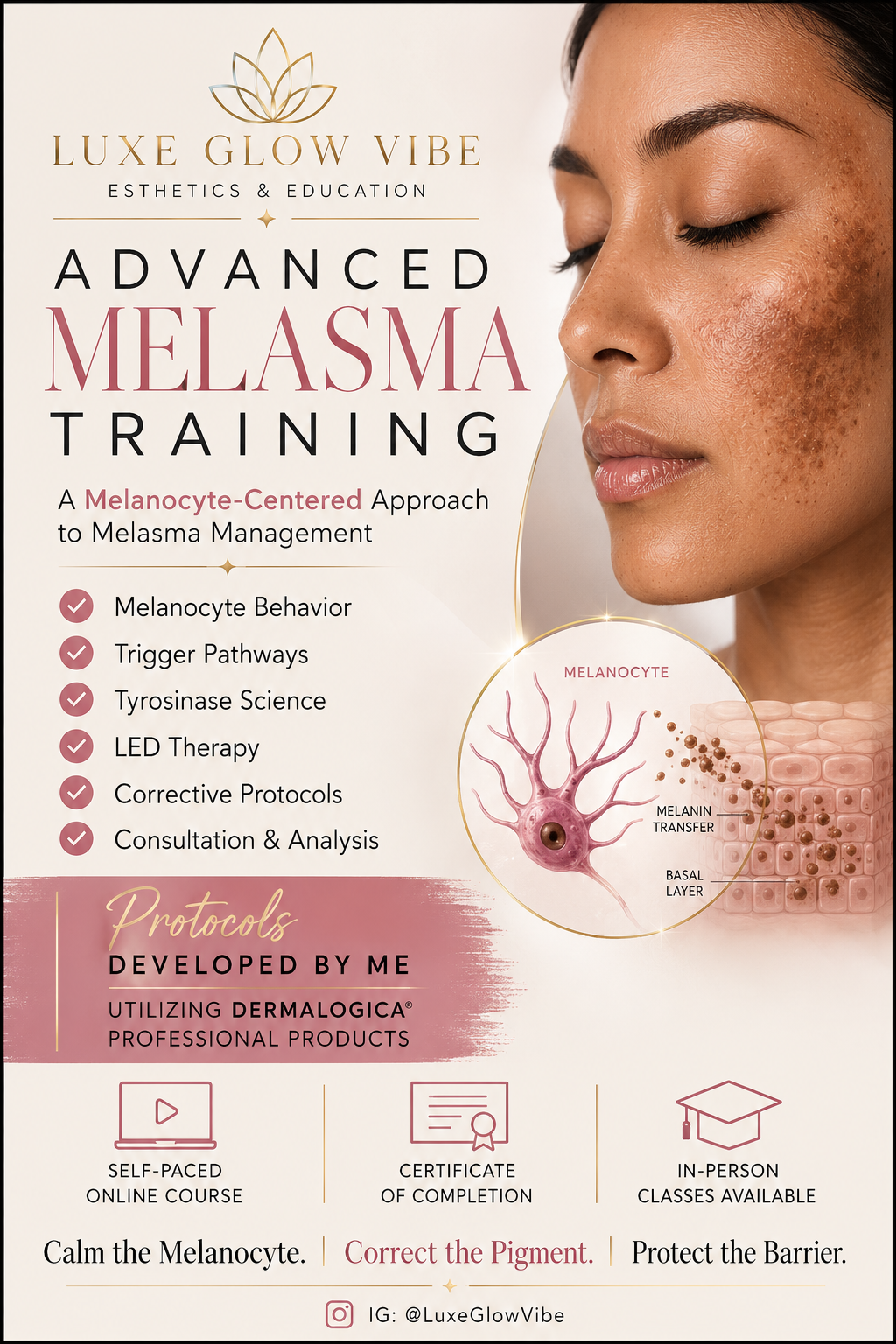
Advanced Melasma Course
🤍 If you’re treating melasma by only treating the pigment, you may be missing the most important part of the equation: the melanocyte.
One of the biggest shifts in my career happened when I stopped asking:
“How do I lighten this pigment?”
And started asking:
“Why is this melanocyte still overreacting?”
Melasma isn’t simply excess pigment sitting in the skin.
It’s a chronic condition involving melanocyte behavior, tyrosinase activity, inflammation, heat sensitivity, hormonal influences, UV exposure, barrier health, and long-term regulation.
Melanocytes are the skin’s pigment-producing cells located in the basal layer of the epidermis. Their job is protective. They produce melanin and distribute it to neighboring keratinocytes through specialized structures called dendrites.
When exposed to UV, heat, hormones, or inflammation, melanocytes increase pigment production as a protective response. In melasma, this protective mechanism becomes dysregulated, causing pigment production to remain active longer than necessary.
Inside the melanocyte, the enzyme tyrosinase acts as the ignition switch for pigment formation:
Tyrosine → DOPA → Dopaquinone → Melanin
When this pathway remains activated by chronic inflammation, hormonal influences, heat exposure, or barrier dysfunction, excess pigment develops.
Importantly, our goal is not to destroy melanocytes or “bleach” the skin, but to calm, regulate, and retrain melanocyte behavior.
Another concept I emphasize in corrective care is that melanocytes can develop a type of “memory.” Even after triggers are removed, chronic stimulation can cause melanocytes to continue producing pigment, which helps explain why melasma is often recurrent and requires long-term management rather than short-term correction.
This perspective ultimately led me to develop my own Advanced Melasma Training program, where I teach a melanocyte-centered, barrier-first approach to melasma management for estheticians seeking a deeper understanding of pigment behavior.
Throughout the course, I teach the corrective protocols I have personally developed for melasma management while demonstrating how I incorporate Dermalogica Professional products within my treatment approach to support long-term pigment management, barrier health, and melanocyte regulation.
The course includes:
🤍 Module 1: Understanding Melasma
• Melasma types and patterns
• Pigment depth
• Melanocyte function
• Why melasma recurs
🤍 Module 2: Trigger Pathways & Melanocyte Behavior
• UV exposure
• Heat
• Hormonal influences
• Inflammation
🤍 Module 3: Tyrosinase Inhibitors & Ingredient Science
• TXA
• Niacinamide
• Azelaic Acid
• Licorice Root
• Vitamin C derivatives
🤍 Module 4: LED Therapy for Pigment Control
• Green LED
• Yellow LED
• LED safety
• Pigment support protocols
🤍 Module 5: Consultation & Analysis
• Client intake
• Fitzpatrick safety
• Trigger assessment
• Documentation
🤍 Module 6: Corrective Protocols & Treatment Planning
• Treatment selection
• Barrier-first correction
• Progressive treatment planning
• Managing expectations
🤍 Module 7: Homecare & Client Education
• Product selection
• Client compliance
• Trigger management
• Long-term maintenance
🤍 Modules 8 & 9: Business, Marketing & Professional Growth
• Positioning yourself as a corrective specialist
• Client communication
• Content strategy
• Mentorship and professional development
Because successful melasma management isn’t about bleaching skin.
It’s about learning how to calm the melanocyte first, correct the pigment gently, and protect the barrier always.
✨ Advanced Melasma Training /
✨ Self-Paced Online Course
✨ Certificate of Completion
✨ In-Person Classes Available
✨ Optional Mentorship
Luxe Glow Vibe Esthetics & Education
IG: @LuxeGlowVibe