Understanding the Fitzpatrick Scale: A Professional's Essential Guide
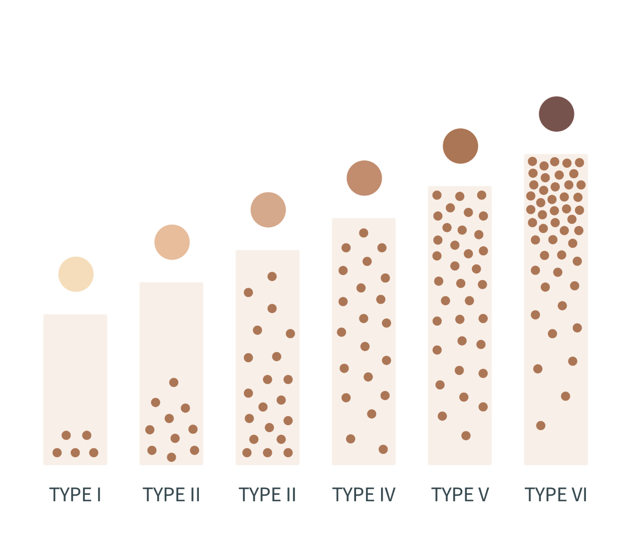
As professionals, we see a wide range of skin tones and types, and while no two clients are ever the same, understanding how skin reacts to light, heat, and trauma is essential to keeping treatments both safe and effective.
That’s where the Fitzpatrick Scale comes in.
What Is the Fitzpatrick Scale?
Developed in 1975 by Harvard dermatologist Dr. Thomas Fitzpatrick, this scale classifies skin into six types based on how it responds to UV exposure, from Type I (very fair, always burns) to Type VI (deeply pigmented, rarely burns).
Originally designed to guide UV dosing for medical treatments, the Fitzpatrick Scale quickly became a universal reference for aesthetic and dermatological procedures. Today, it helps us predict a client’s sensitivity, healing rate, and risk for pigmentation.
Why It Matters in the Treatment Room
1. Assessing Risk for Pigmentation
Higher Fitzpatrick types (IV–VI) are more prone to post-inflammatory hyperpigmentation (PIH) after certain treatments. A peel or resurfacing method that’s safe for Type II skin could trigger unwanted pigment in Type V if adjustments aren’t made.
2. Customizing Treatment Parameters
Energy-based devices, exfoliants, and peels all rely on your client’s melanin density and sensitivity. Fitzpatrick assessment helps you set the right intensity, avoiding burns, inflammation, or underwhelming results.
3. Choosing the Right Ingredients and Peels
Not all acids or exfoliants are suitable for every type, for example, darker skin tones often respond best to gentler acids like mandelic or lactic, while lighter types may tolerate glycolic or stronger resurfacing formulas like trichloroacetic acid.
4. Setting Realistic Expectations
Explaining how a client’s skin type influences treatment outcomes builds trust. For example, laser hair removal may take more sessions for deeper Fitzpatrick types, but it’s safer and more predictable when planned properly.
Beyond the Basics: Knowing Its Limits
The Fitzpatrick Scale is an incredible foundation, but it’s not the whole story.
It was developed using a limited range of skin types and doesn’t fully account for undertones, ethnic diversity, or genetic variations in melanin distribution.
That’s why the best therapists use Fitzpatrick typing as a starting point, then layer on:
A thorough consultation and visual analysis
An understanding of the client’s heritage and sensitivity history
Patch testing for higher-risk procedures
Ongoing observation and documentation across visits
Putting It into Practice
Take a moment during consultation to understand your client’s Fitzpatrick skin type and how their skin responds to light.
Document it in your intake form and reference it when choosing peels, lasers, or exfoliation depth.
Revisit your protocols regularly to ensure they reflect both Fitzpatrick type and modern inclusivity.
The more precisely we understand how skin responds, the safer and more personalized every treatment becomes.
Final Thought
The Fitzpatrick Scale isn’t just a chart, it’s a safety tool that helps us protect skin health and deliver results with confidence.
Every decision you make, from your choice of exfoliant to your LED timing, starts with understanding how your client’s skin will respond.