The Sodium Silicate Illusion: What's Really Happening When Under-Eye Bags "Disappear"?
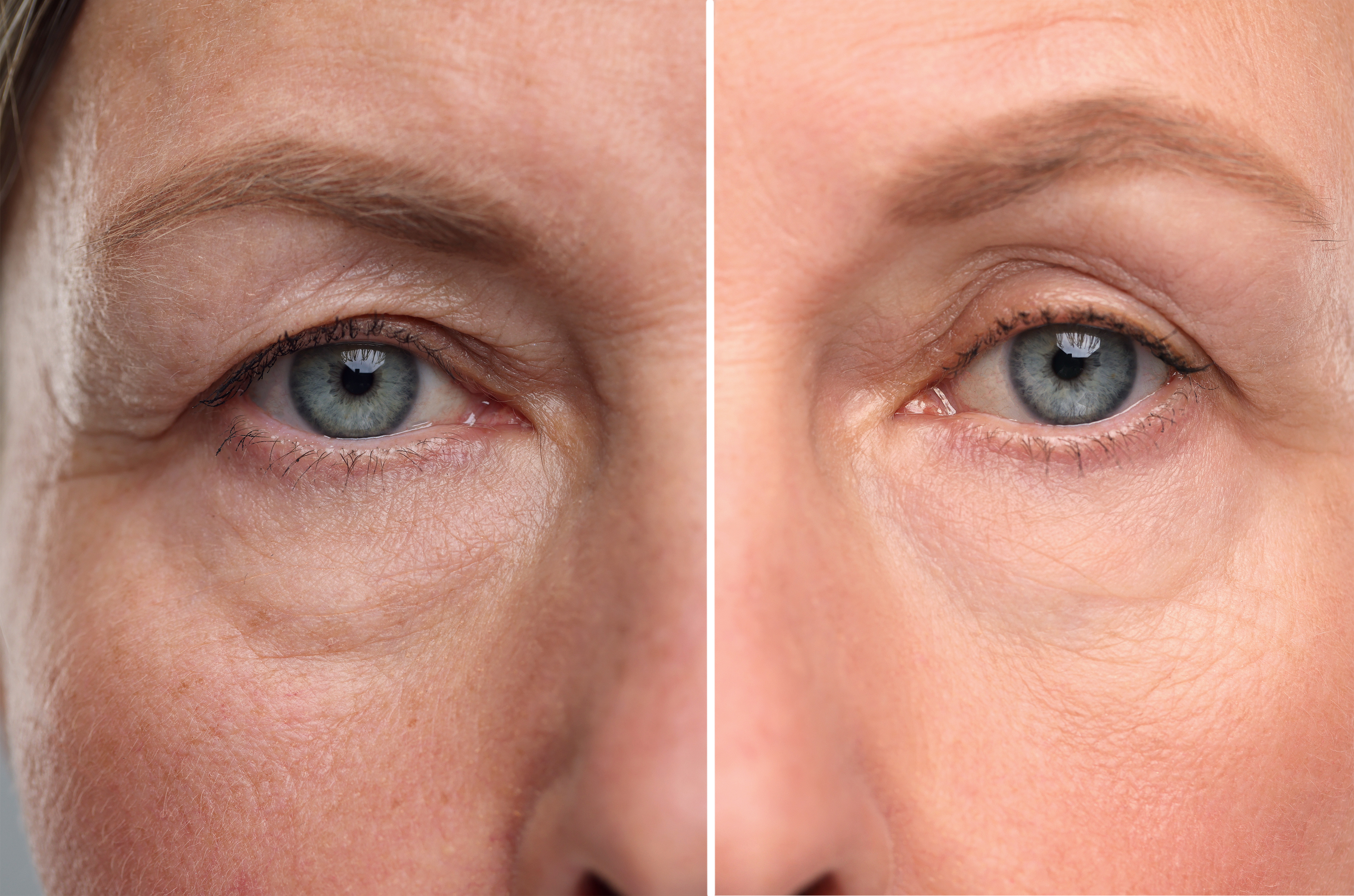
If you've spent more than five minutes on social media lately, you've probably seen it.
A creator applies a cream beneath the eye. Within a minute or two, puffiness seems to melt away. Eye bags vanish. Wrinkles appear to tighten. Comments flood in asking, "What is this magic?"
The ingredient responsible for many of these viral transformations isn't a new peptide, an advanced growth factor, or a breakthrough longevity ingredient.
It's sodium silicate.
So...what exactly is sodium silicate?
Sodium silicate is an inorganic mineral compound, sometimes called "liquid glass." While it has legitimate uses in industrial applications, in cosmetics it's primarily valued for one very specific reason: it forms a rigid film as it dries.
As water evaporates, that film contracts. The result is a temporary tightening effect that physically pulls the skin surface taut.
It's less about changing the biology of the skin and more about creating a mechanical effect.
Think of it as shrink wrap rather than skincare.
Why does it look so dramatic?
The under-eye area is the perfect stage for this kind of demonstration.
The skin is incredibly thin, even subtle tightening becomes highly visible, and clever lighting, camera angles, and expression changes can make the results look almost unbelievable.
For someone preparing for an event, a photo shoot, or a few hours on camera, these products can absolutely have a place.
But they're often being presented as if they're treating under-eye bags.
They're not.
Skin change vs. skin trick
As skin professionals, one of our biggest responsibilities is helping clients understand the difference between a cosmetic effect and a biological improvement.
A temporary film-forming polymer doesn't:
reduce fat pad protrusion
improve lymphatic drainage
rebuild collagen
strengthen the dermal matrix
correct skin laxity
The eye bag returns as soon as the film is disrupted by facial movement, oils, moisturizers, sunscreen, or simply washing the product away.
That's not necessarily a criticism, it just means we need to call it what it is.
A cosmetic illusion.
The catch
These products also come with compromises.
Because the film becomes quite rigid, many users report:
a tight or uncomfortable sensation
visible white residue or flaking
cracking with facial expression
difficulty layering makeup or sunscreen
an unnaturally "frozen" appearance
Ironically, the very thing creating the tightening effect can sometimes make the product more obvious than the eye bag itself.
Why are they so popular?
We're living in the age of immediate gratification.
A treatment that stimulates collagen may take months.
Improving sleep, allergies, lymphatic function or skin quality takes consistency.
A 90-second transformation fits perfectly into today's social media algorithms.
The visual payoff is instant, even if the result is temporary.
What should we be telling clients?
Rather than dismissing these products, there's an opportunity to educate.
A simple way to frame the conversation is:
"This product can temporarily tighten the appearance of the skin for a few hours. If that's what you're looking for before a special occasion, it may be useful. But if your goal is actually improving under-eye bags over time, that's a different conversation entirely."
That conversation might include topical ingredients that support skin health, professional treatments, lifestyle factors, or even referral when anatomy, not skincare, is the primary cause.
The bigger lesson
Social media has blurred the line between skincare and special effects.
Not every viral ingredient is bad.
Not every dramatic before-and-after is misleading.
But as professionals, our value isn't simply knowing what works.
It's understanding how it works, why it works, and whether the effect is biological, cosmetic, or somewhere in between.
Sodium silicate isn't revolutionary.
It just reminds us that sometimes the most impressive transformation isn't changing the skin at all, it's changing what we think we're seeing.