Professional’s Guide to Advanced Treatments: Chemical Peels
Chemical peels have long been a part of professional skincare, yet their role in the modern treatment room is often misunderstood. Sometimes viewed as outdated, overly aggressive, or interchangeable, peels are frequently reduced to surface-level descriptions that overlook their true value.
When selected and applied with intention, chemical peels remain one of the most versatile and effective advanced treatments available. They can elevate treatment outcomes, expand a provider’s service offerings, and support long-term skin health, provided they are used thoughtfully and responsibly.
The Role of Chemical Peels in a Modern Practice
Offering chemical peels as part of a professional service menu enhances both the quality and range of care provided. Peels allow professionals to address a wide variety of concerns while maintaining control over treatment depth, frequency, and recovery.
Rather than serving as a “one-size-fits-all” solution, peels function best as a strategic treatment tool, one that requires assessment, customization, and timing. Their value lies not in intensity, but in precision.
When integrated properly, chemical peels support treatment outcomes and sustainable practice growth.
Chemical Peels as an Effective Advanced Treatment
Chemical peels work through controlled exfoliation to encourage skin renewal and improve function. Depending on formulation and application, peels may be used to support:
Acne and congestion
Pigmentation irregularities
Uneven texture
Early signs of aging
Dull or sluggish skin behavior
When the skin is appropriately prepared and the treatment is selected with care, results tend to be reliable and progressive.
However, effectiveness is not determined by peel strength alone. Skin condition, barrier integrity, inflammation level, and treatment frequency all influence outcomes. Without proper assessment, even well-formulated peels can lead to irritation, delayed recovery, or compromised results.

Understanding Peel Depth and Mechanism
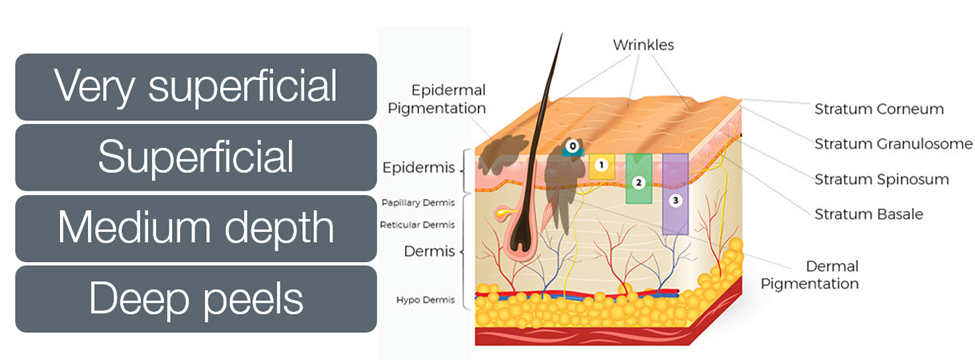
Peel depth is often described in the categories of: very superficial, superficial, medium, or deep peel. In practice, depth is contextual rather than fixed.
How a peel behaves depends on multiple variables, including:
The agent or agents used
pH and concentration
Vehicle or carrier system
Contact time
Skin barrier integrity
Baseline inflammation
Frequency of application
A superficial peel may act far more aggressively on compromised or inflamed skin, while the same peel may remain well-tolerated on healthy, resilient skin.
Beyond depth, it is essential to understand peeling agents.
Keratolytic agents (AHAs and BHAs) primarily work by disrupting the bonds between corneocytes, encouraging controlled shedding and improving flow through the stratum corneum. These agents are commonly used to regulate congestion, normalize desquamation, and improve skin texture when used appropriately.
Keratocoagulant agents (TCA) act by denaturing proteins within the skin, creating a controlled coagulation response. These agents are typically associated with deeper injury, increased inflammation, and a greater reliance on the skin’s healing capacity.
Understanding whether a peel relies more heavily on keratolytic or keratocoagulant activity, or a combination of both, allows professionals to better predict skin response and recovery.
Customization, Client Selection, and Timing
One of the greatest strengths of chemical peels is their ability to be customized. Successful peel outcomes depend on matching the treatment to the individual skin, not just the presenting concern.
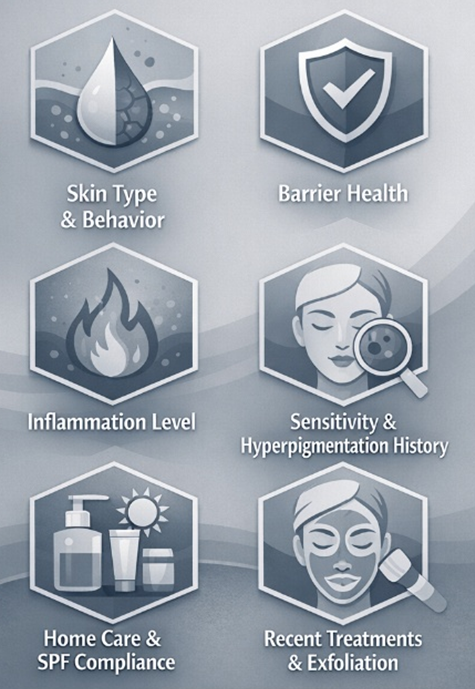
Key factors to consider include:
Skin type and behavior
Barrier health
Inflammation level
History of sensitivity or post-inflammatory hyperpigmentation
Current home care routine and SPF compliance
Recent treatments or exfoliation
Not every client who requests a peel is ready to receive one. Peels should be modified or delayed when the skin shows signs of barrier impairment, active inflammation, or reactivity.
Preparation matters. Supporting barrier function, reducing inflammation, and aligning home care prior to treatment are often more impactful than increasing peel strength. Timing and restraint frequently produce better long-term results than aggressive correction.
Chemical Peels as a Strategic Professional Tool
Chemical peels are not standardized treatments, they require assessment, customization, education and professional judgment. When performed within appropriate scope and with proper training, they allow professionals to deliver advanced care safely and ethically.
From a practice standpoint, peels offer long-term value. They are a high-demand service that can be structured into treatment series, integrated with other modalities, and supported through personalized home care. More importantly, peel education strengthens overall clinical thinking, improving decision-making across advanced treatments.
When approached with intention, peels enhance treatment quality, elevate professional expertise, and support sustainable practice growth.
In advanced skincare, the most effective treatments are don’t have to be the most aggressive.